
Appearance
Keyword Tracker
Monitor and Optimize Your Podcast's Visibility
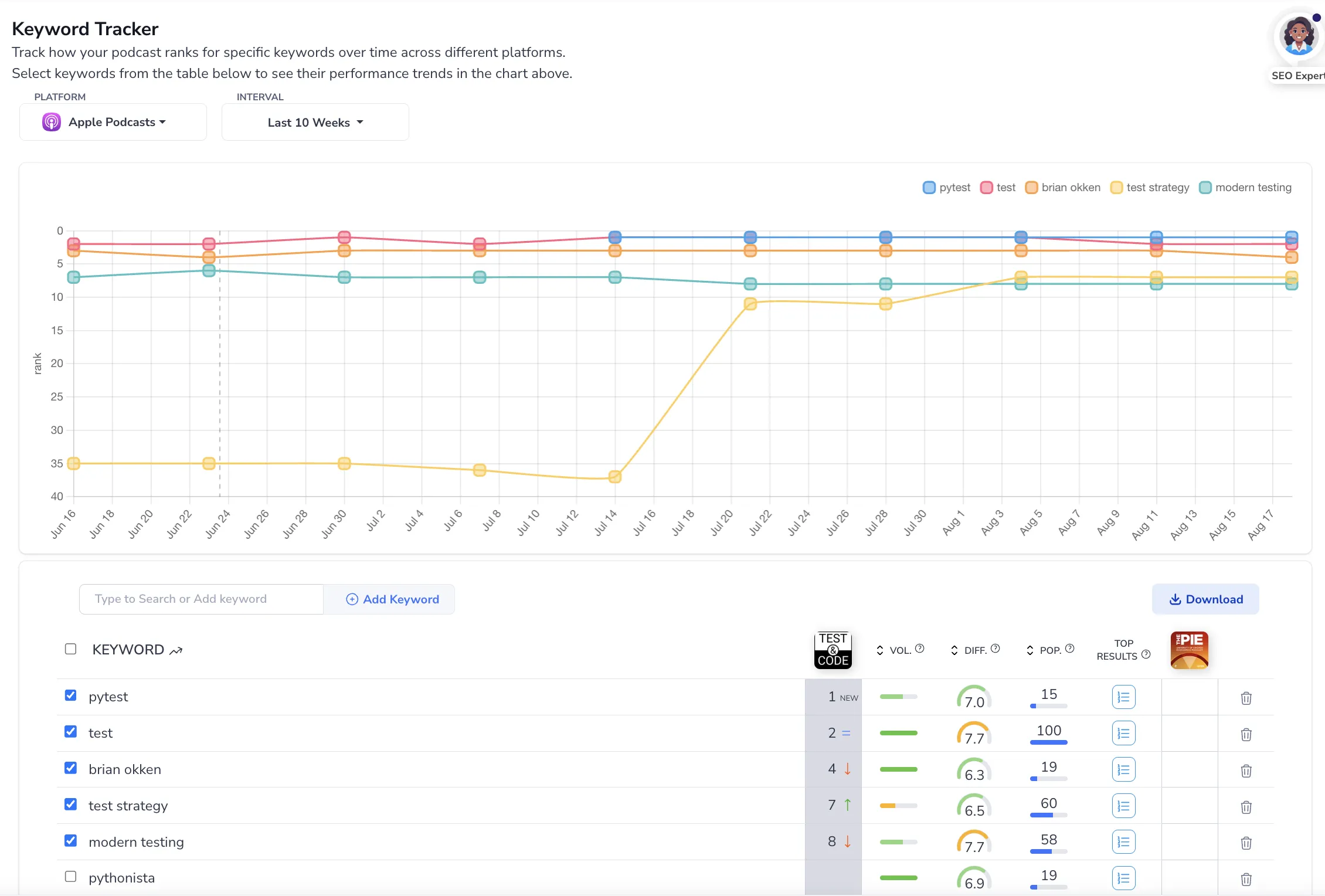
The Keyword Tracker is your ultimate tool to monitor the performance of your podcast across important search terms. It helps you track rankings, analyze trends, and refine your SEO strategy to outperform competitors. In the app's Search Visibility navigation, this feature appears as the Tracker tab (its full name is Keyword Tracker).
Important: This feature works with the keywords you track from your Keyword Strategy. The Keyword Tracker is primarily for analyzing the performance of already-tracked keywords, but you can also add new keywords and delete existing ones directly on this page. For full keyword planning—organizing terms into Primary, Secondary, and Monitored tiers—the Keyword Strategy page remains your central hub.
Features at a Glance
Track Keyword Performance Over Time
Visualize keyword ranking trends for your podcast across platforms like Spotify, Apple Podcasts, Amazon Music, and YouTube Music, plus YouTube itself when PodSEO knows your podcast's YouTube channel (see YouTube rankings below).
Interactive charts display how rankings shift over time, giving you insights into what’s working and what needs improvement.
View Current Rankings
Quickly check the current results for any keyword by clicking Top Results in its row
This allows you to see exactly where your podcast or competitors rank for that keyword right now.
Compare Keywords
Track multiple keywords to identify which ones drive the most visibility and which need optimization
Spot trends across platforms and pinpoint growth opportunities.
Platform and Time Interval Filters
Switch between Spotify, Apple Podcasts, Amazon Music, YouTube Music, and (when available) YouTube to analyze keyword performance on each platform.
Adjust the time interval—Last 15 Days, Last 30 Days, or Last 10 Weeks—to focus on short-term trends or longer-term growth.
Competitive Insights
See which podcasts rank for your tracked keywords and identify competitors dominating key search terms.
The table will dynamically add columns for each of your tracked competitors, allowing you to compare rankings side-by-side.
Volume, Popularity and Difficulty Metrics
Volume (VOL.): Roughly how many times a month people search for the keyword, shown as a 6-step green meter with six levels: Very niche (under 100 searches a month), Niche (100–250), Small (250–1K), Medium (1K–2.5K), Popular (2.5K–10K), and Very popular (10K+). Hover over the meter (or focus it) to see the level and range, for example "Small · 250–1K searches/mo". On mobile, each keyword card shows the meter with the range, such as "250–1K/mo". A clock icon means the keyword hasn't been measured yet; it fills in after the next periodic check. Niche keywords aren't a weakness: fewer people search for them, but they're usually easier to rank for.
Popularity (POP.): How crowded the keyword is on the selected platform: how many shows and episodes already rank for it, from 0-100%. Lower popularity means less competition and more room for your podcast.
Difficulty (DIFF.): Measures how competitive it is to rank for the keyword, helping you prioritize achievable goals.
Top Results Modal
- Click the "Top Results" button for any keyword to see the top 50 podcasts ranking for that keyword on the selected platform.
CSV Download
- Download the currently filtered keyword data as a CSV file for your own analysis. The Search volume (searches/mo) column holds each keyword's monthly range (for example "1K-2.5K") and is empty for keywords that haven't been measured yet.
How to Use
Analyze Rankings
Use the interactive chart to track trends over time. Hover over data points to view ranking details for specific dates.Check Current Rankings
Click Top Results next to a keyword to see the top 50 podcasts currently ranking for it on the selected platform.Compare Competitors
Scroll through the table to see which podcasts rank for each keyword. Identify and analyze competitors to refine your strategy.Filter Platforms and Keywords
Use platform filters to focus on Spotify, Apple, Amazon Music, YouTube Music, or YouTube data. Toggle individual keywords for more precise insights.
Search Countries
By default, keyword rankings in Tracker are what a listener in the United States would see. Platform search results differ by country — the same keyword can return a different order in the UK, Germany, or Australia — so if your audience is elsewhere, US results may not match what your listeners experience.
On paid plans you can add search countries per podcast:
- Go to Settings → Podcasts and find the Search countries row for the podcast. The US is always included; click the + button to add another country. Only countries that every supported platform can serve are offered.
- Back in Keyword Tracker, use the country selector next to the platform and timeframe filters to switch the chart and table between your tracked countries. The bottom of the Country dropdown also has an Add countries link (or Manage countries once you've added some) that takes you straight to this setting.
- When you first add a country you'll see a Collecting notice — the first rankings for that country land within about 24 hours. If a country's data hasn't been refreshed recently, the tracker labels it as possibly out of date; if a platform can't be searched from that country yet, it says so instead of showing a blank chart.
Allowance by plan. Beyond the included US results, paid plans can track additional countries per podcast: Podcaster 1, Producer 5, Agency 10, Enterprise unlimited. Free accounts see US rankings only. If you move to a plan with a smaller allowance, your extra countries stay listed but are flagged over plan and stop updating until you remove others; removing a country works on every plan.
Search countries are separate from the countries used in My Charts (chart positions) and from the Apple storefronts listed in Ratings & Reviews. Adding a search country only affects keyword rankings.
Why rankings may differ from what you see on your phone. Your own app shows results for your device's storefront, language, and — on some platforms — your listening history. PodSEO collects results as a neutral listener in the selected country, so small differences are normal; large, persistent differences usually mean you're comparing against a country you haven't added.
YouTube Rankings
YouTube and YouTube Music are separate platforms in the tracker. YouTube Music is the podcast directory inside the YouTube Music app, where your show appears as a podcast. YouTube is the regular youtube.com search, where people find your videos.
On YouTube, PodSEO ranks your channel: if any of your channel's videos, playlists, or the channel itself appears in the results for a keyword, the best of those positions is your rank. This shows whether your video content is being found for the same keywords you target on the podcast apps.
The YouTube option appears for podcasts that PodSEO has linked to a YouTube channel. The most reliable way to make sure your channel is linked is to connect it in YouTube Insights or Social Publishing; PodSEO can also recognize it from public YouTube information. A few things to know:
- YouTube rankings are collected as a US viewer, even if you've added other search countries.
- YouTube rankings don't affect your Visibility Score, which is built from the podcast platforms.
- To see which actual searches bring viewers to your videos (rather than where you rank for your own keywords), use the YouTube searches list in YouTube Insights.
Why It Matters
The Keyword Tracker provides actionable insights into your podcast’s discoverability. With tools to track performance, compare competitors, and understand rankings across platforms, you can optimize your SEO strategy to grow your audience and outrank competitors.
Pro Tip
Check Top Results often to stay up-to-date with your current keyword rankings. Use the insights to adapt your release schedules or metadata strategy to gain a competitive edge.
Plan Restrictions
- Primary Keywords: Maximum 3 across all plans (hard limit enforced).
- Secondary & Monitored: The number of keywords you can track is based on your plan. If you exceed your plan's limit, you will see an "Over-Quota Warning".
- Chart Display: All tracked keywords visible in performance charts.
- Historical Data: Keyword ranking trends over time are available on all plans, using the Last 15 Days, Last 30 Days, and Last 10 Weeks intervals.