
Appearance
PodSEO Keyword Workflow
Welcome to PodSEO! This guide walks you through the complete keyword optimization workflow to improve your podcast's visibility on Apple Podcasts, Spotify, Amazon Music, and YouTube Music.
The Optimization Cycle
Podcast SEO is an iterative process. Each optimization cycle follows these phases:
- Discover - Identify keywords that are candidates for optimization
- Prioritize - Select which keywords to actively optimize (Primary and Secondary)
- Optimize - Implement SEO Analysis recommendations to improve rankings
- Monitor - Track ranking movements to validate the strategy
- Validate - Confirm that improved rankings translate to new listeners
- Iterate - Graduate successful keywords and start a new cycle
This workflow ensures you're not just improving rankings, but actually attracting new listeners who become subscribers.
Step 1: Add Your Podcast
After logging in, you'll see the "Select Your Podcast" screen. Click Find Your Podcast to search for your show on Apple Podcasts.

Search for your podcast using its name or author details, then select it from the results. PodSEO will automatically sync data from Apple Podcasts, Spotify, Amazon Music, and YouTube Music.
Step 2: Identify Keyword Candidates
Before setting your keyword strategy, you need to identify keywords worth optimizing. PodSEO provides several sources for discovering candidate keywords:
Source 1: Show Visibility (Quick Wins)
Go to Show Visibility to see keywords your podcast already ranks for. This is your most valuable source for "quick wins" - keywords where you're close to top positions.
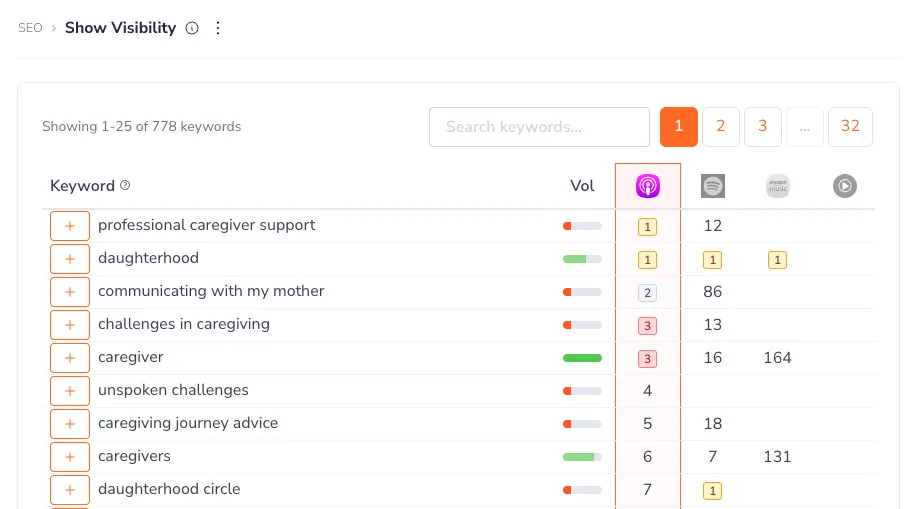
What to look for:
- Quick wins: Keywords ranking #6-15 that could be pushed into the top 5 with optimization
- Near-top positions: Rankings #4-5 that could reach #1-3 with focused effort
- Platform gaps: Keywords ranking well on one platform but poorly on others
Why this matters: Ranking below position #5 is like being on the second page of Google - most listeners never see you. Moving from #8 to #3 can dramatically increase discovery.
Click the "Track" button on promising keywords to add them to your monitoring list.
Source 2: Episode Visibility (Hidden Gems)
Check Episode Visibility to see which keywords individual episodes rank for. This is especially valuable for identifying audience-relevant keywords.
Look for outlier episodes - episodes with unusually high downloads often rank for keywords that resonate with your ideal audience. The keywords driving traffic to your best-performing episodes are strong candidates for show-level optimization.
Source 3: AI Suggestions (Topic Relevance)
In the Keyword Strategy section, use the "AI Suggestions" tab to discover keywords recommended based on your podcast's content.
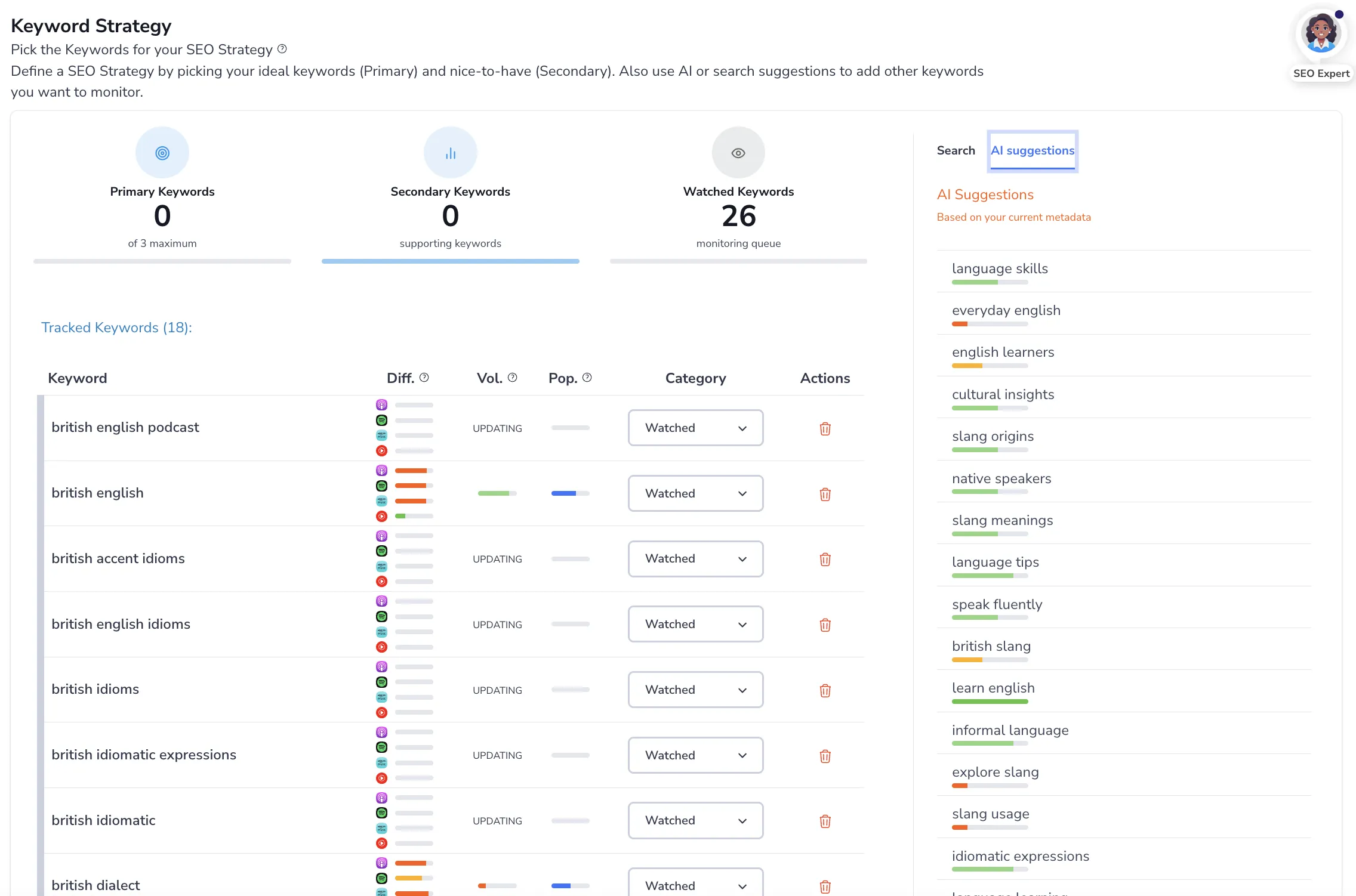
These suggestions identify keywords that:
- Are relevant to your podcast's topics and themes
- Are likely to be searched by your ideal audience
- May not appear in your current rankings but represent growth opportunities
Source 4: Manual Search
Use the search bar in Keyword Strategy to explore specific keywords you believe your audience searches for.
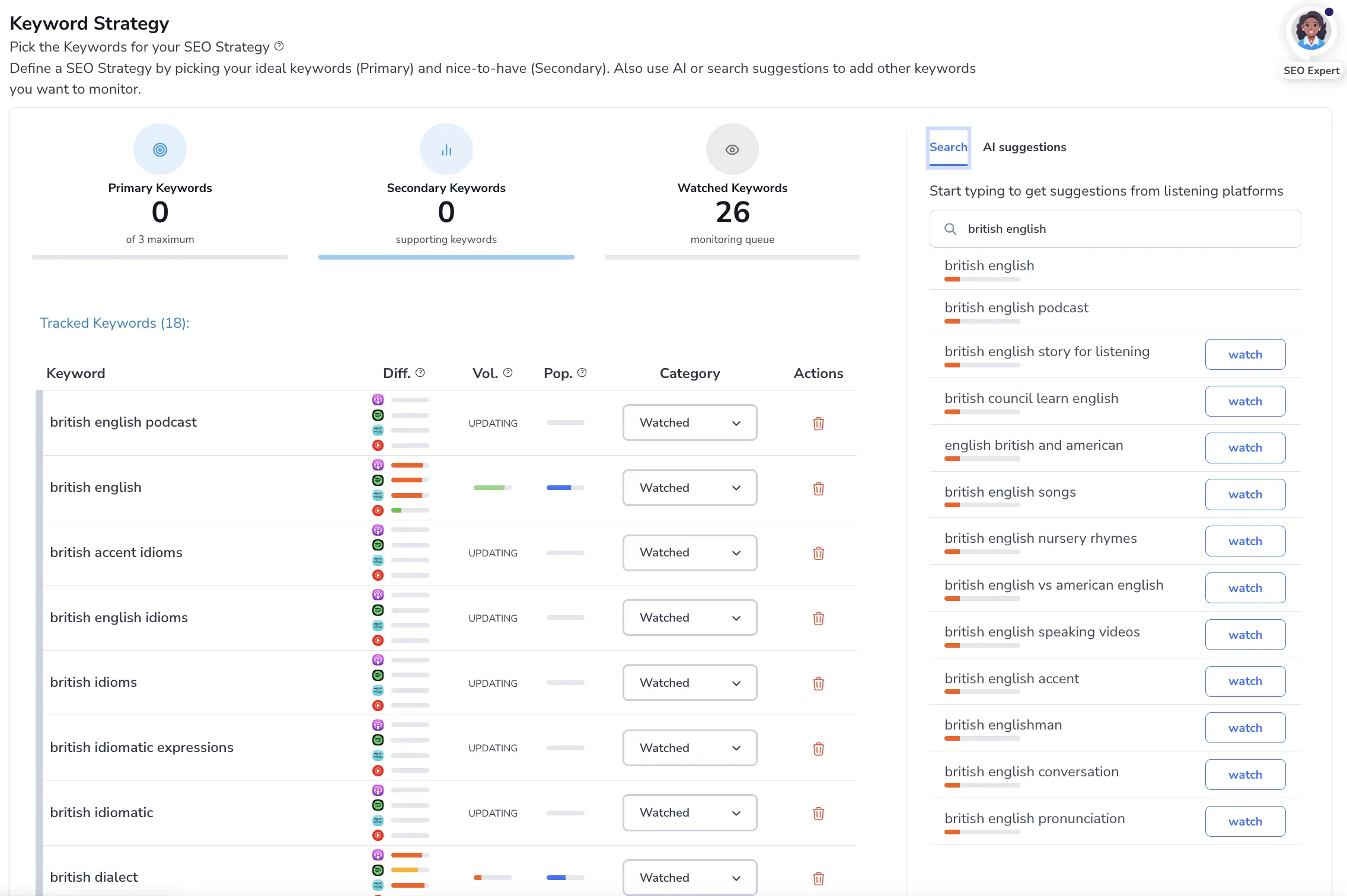
Track all promising keywords by clicking the "watch" button. These will appear as "Monitored" keywords in your Keyword Strategy, giving you data to inform your optimization decisions.
Step 3: Set Up Your Keyword Strategy
With candidate keywords identified and tracked, it's time to prioritize which ones to actively optimize.
Understanding Keyword Tiers
- Primary Keywords (max 3): Your current optimization focus. These drive AI recommendations in SEO Analysis.
- Secondary Keywords (unlimited): Supporting keywords that also influence recommendations.
- Monitored Keywords (unlimited): Keywords you're tracking but not actively optimizing yet.
Selection Criteria
When promoting keywords from Monitored to Primary or Secondary, consider:
Volume: Estimated monthly search volume for the keyword. Higher volume means more potential listeners, but also typically more competition.
Difficulty: A metric based on how visible and popular the podcasts already ranking in top positions are - calculated platform by platform. Lower difficulty means easier to compete.
Strategic balance: Aim for a mix of:
- 1-2 achievable keywords (lower difficulty, moderate volume)
- 1 aspirational keyword (higher volume, higher difficulty)
Setting Your Strategy
In Keyword Strategy, use the dropdown selector to promote your chosen keywords:
- Select 2-3 keywords as Primary - these are your immediate optimization targets
- Select additional keywords as Secondary - these support your strategy and will be tracked
- Keep other promising keywords as Monitored for future optimization cycles
Step 4: Run SEO Analysis
With your keyword strategy defined, navigate to SEO Analysis to get actionable optimization recommendations.
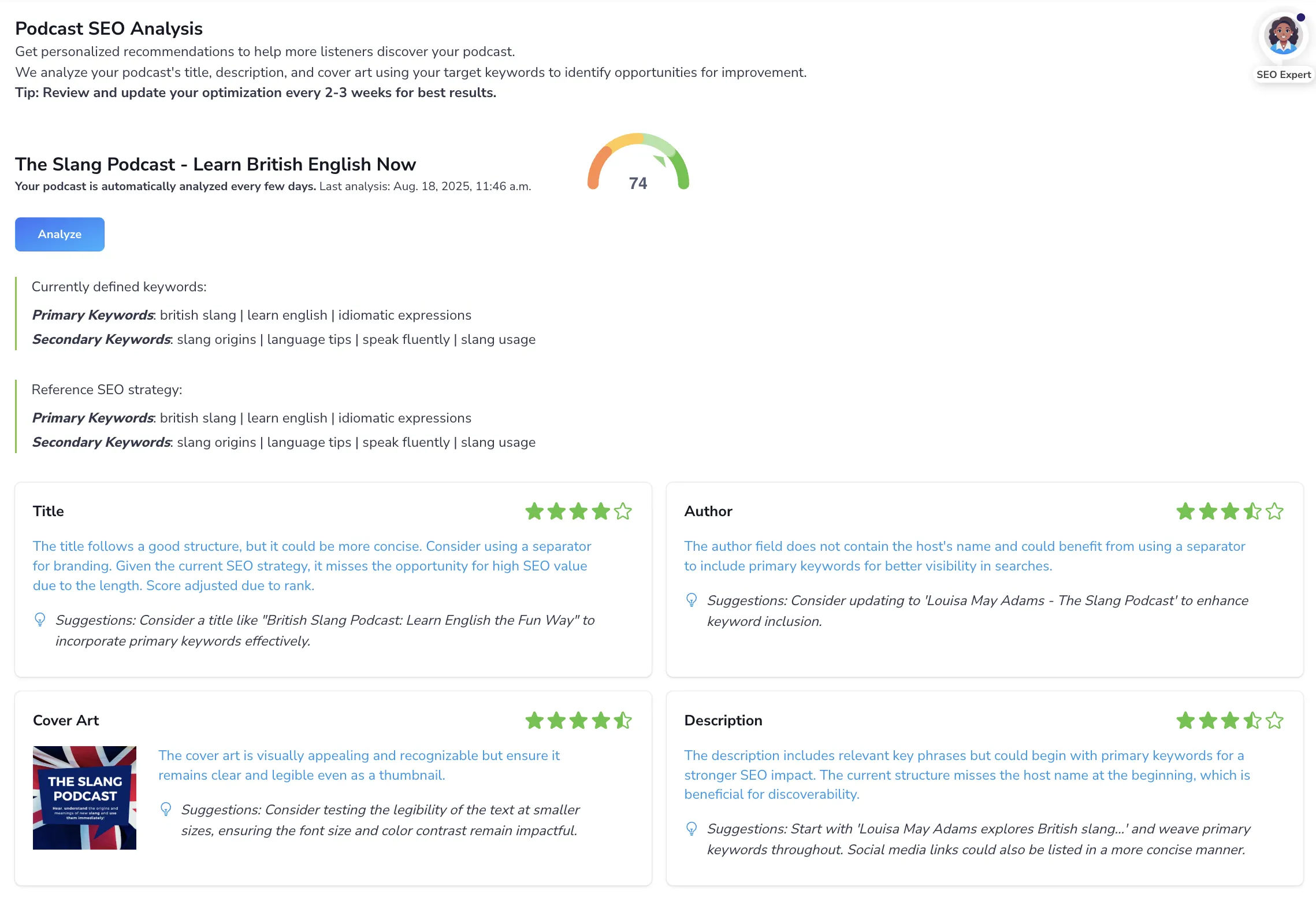
SEO Analysis provides AI-powered recommendations tailored to your Primary and Secondary keywords:
- Title Analysis: How to incorporate keywords naturally into your podcast title
- Author Analysis: Optimization suggestions for the author field
- Description Analysis: Keyword integration and structure recommendations (paid plans)
- Cover Art Analysis: Visual optimization feedback (paid plans)
- Episode Analysis: Per-episode optimization suggestions (paid plans)
Implement the recommendations in your podcast's metadata through your hosting platform. Focus on natural keyword integration - avoid keyword stuffing, which platforms penalize.
Step 5: Monitor and Validate
After implementing changes, monitor your results over the following days and weeks.
Track Ranking Movements
Use Keyword Tracker to monitor how your rankings change after optimization.
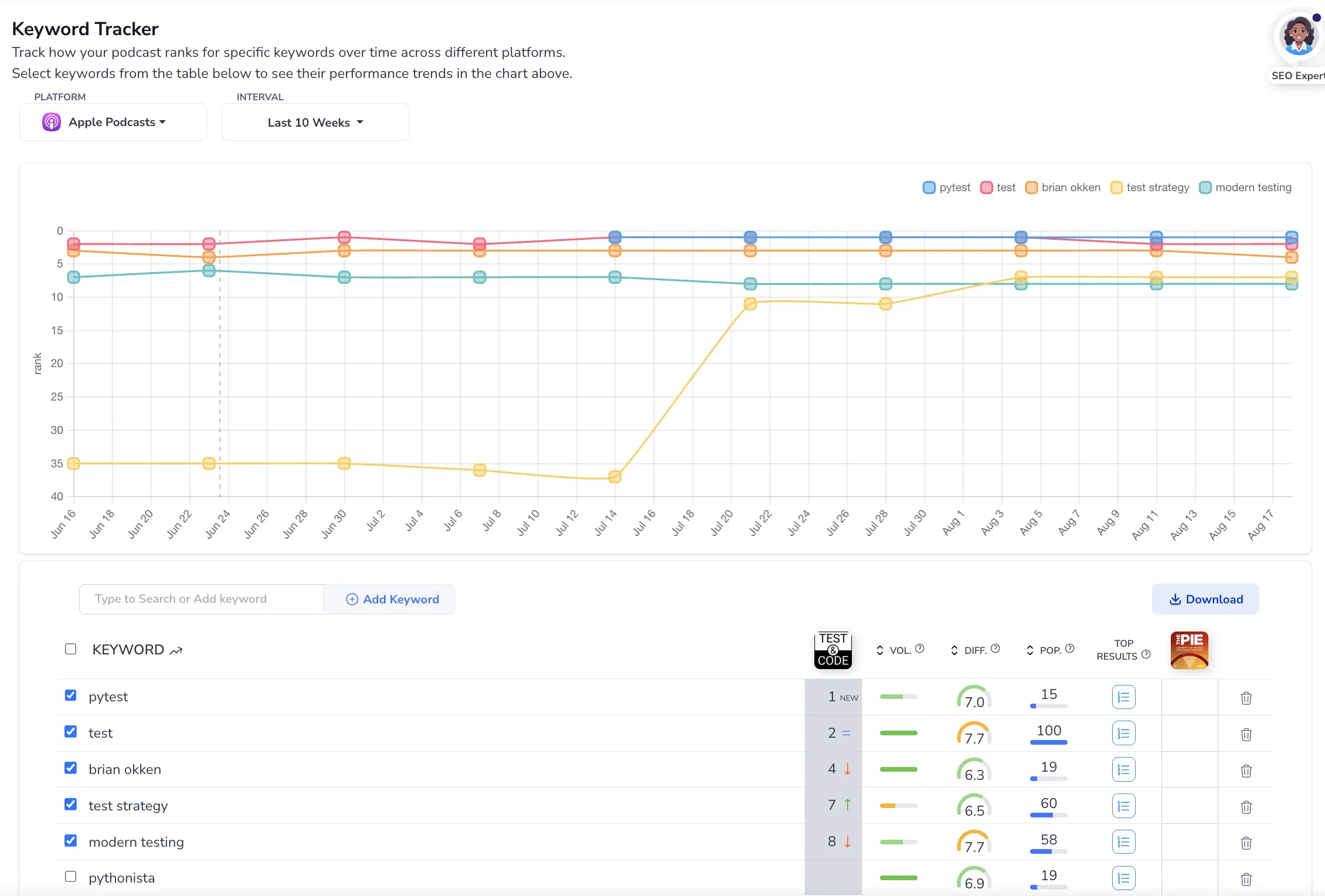
What to watch for:
- Position improvements for your Primary keywords
- Movement toward top 5 positions (the high-visibility zone)
- Platform-specific progress (you may improve faster on some platforms)
Timeline expectations:
- Initial ranking changes: 1-2 weeks
- Significant improvements: 2-4 weeks
- Full impact: 4-8 weeks
Validate with Downloads
Improved rankings are only valuable if they attract new listeners. After achieving better positions (ideally top 5), monitor whether your downloads increase.
If downloads increase: This confirms the keywords attract your target audience. Keep these keywords in your strategy to continue building your subscriber base around these topics.
If rankings improve but downloads don't: The keyword may not match listener intent. Consider whether the keyword truly represents what your ideal audience searches for.
Step 6: Iterate and Expand
Once you've validated a successful optimization cycle:
- Graduate successful Primary keywords to Secondary - they're now "working keywords" that should be maintained
- Select new Primary keywords from your Monitored list
- Start a new optimization cycle with fresh targets
This iterative approach builds sustainable growth by continuously expanding the keywords that drive new listeners to your podcast.
Quick Reference: Keyword Tracker Metrics
- Top 50 Podcasts: Click to see which podcasts rank for each keyword
- Popularity: Score from 0-100 indicating how often the keyword is searched
- Difficulty: Score from 0-10 showing competition level (lower = easier to rank)
- Rank Over Time: Historical chart showing your ranking progression
Next Steps
Once you've mastered the keyword workflow, explore these advanced features:
- Competitive Analysis: Compare your podcast with successful competitors and learn from their strategies
- Find Competitors: Discover podcasts ranking for the same keywords as you
- Timeline: Monitor competitor activity and identify strategic opportunities
- Next Steps: Get personalized optimization quests based on your performance
- LUCIA AI Assistant: Ask questions and get expert guidance on podcast SEO strategies
For more help, check out our Getting Started guide or browse the complete feature documentation.