
Appearance
Positioning Strategy
Define Your Podcast's Strategic Identity
Positioning Strategy (a tab in the Command Center; the page is titled Podcast Positioning) helps you articulate what makes your podcast unique across six key dimensions. By clearly defining your subject matter, audience, value proposition, style, listening context, and differentiators, you create a strategic foundation that guides your content and optimization efforts.
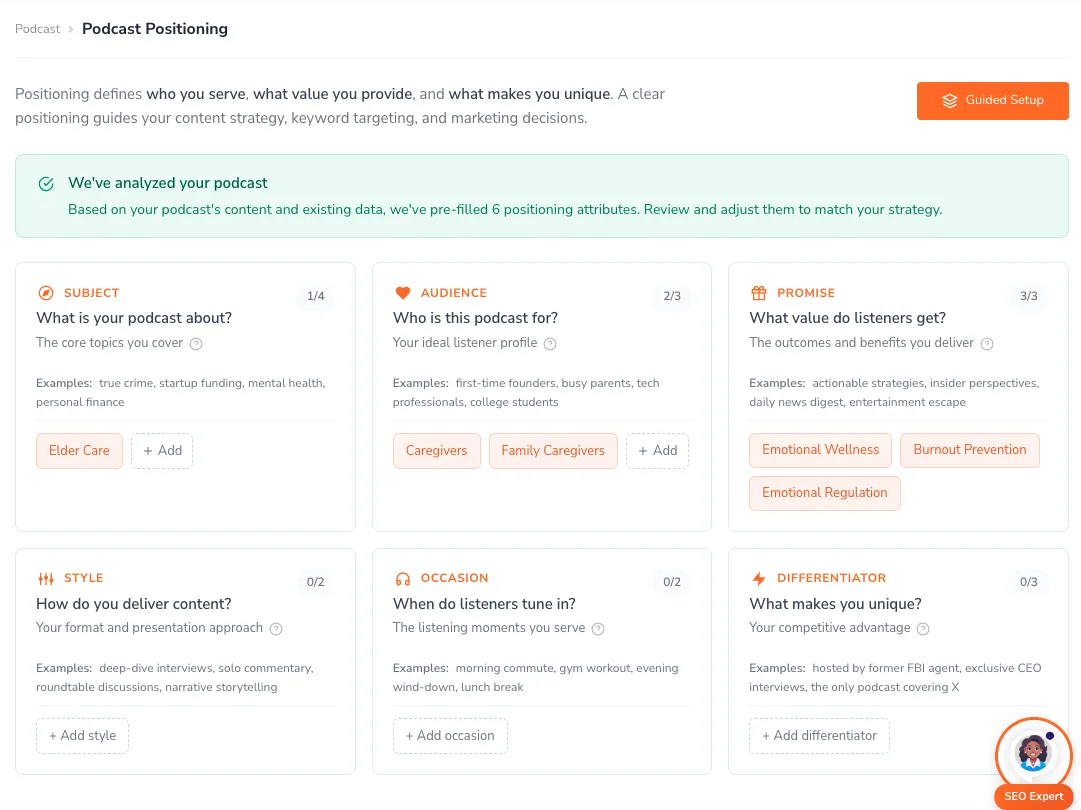
To access: Click Command Center in the sidebar, then open the Positioning Strategy tab.
Why Positioning Matters
A well-defined podcast position helps you:
- Stand out in search results by focusing on specific topics and audiences
- Create consistent content that resonates with your ideal listeners
- Optimize effectively by knowing which keywords and topics matter most
- Attract the right audience by clearly communicating your value
The Six Positioning Dimensions
Positioning guides you through defining your podcast across six color-coded dimensions:
Subject (Blue)
What topics does your podcast cover?
Define the core subjects your podcast explores. Be specific enough to stand out, but broad enough to sustain content. You can select up to 4 subjects.
Examples: true crime investigations, startup funding, personal finance, mindfulness practices
Audience (Purple)
Who is your ideal listener?
Identify the specific people your podcast serves. Understanding your audience helps you create content that resonates and choose keywords that reach the right listeners. Select up to 3 audiences.
Examples: first-time entrepreneurs, busy parents, college students, small business owners
Promise (Green)
What value do listeners get?
Articulate the benefit listeners receive from your podcast. This is your value proposition - what transformation or outcome you deliver. Select up to 3 promises.
Examples: actionable business advice, entertainment during commutes, inspiration for creative projects
Style (Amber)
How do you deliver your content?
Define your podcast's format and delivery approach. Your style affects how listeners perceive and engage with your content. Select up to 2 style elements.
Examples: conversational interviews, solo deep-dives, storytelling narrative, panel discussions
Listening Context (Pink)
When do listeners tune in?
Identify the situations and moments when people listen to your podcast. Understanding listening context helps you optimize episode length and content structure. Select up to 2 contexts.
Examples: morning commute, workout sessions, evening wind-down, weekend learning
Differentiator (Red)
What makes you unique?
Articulate your competitive advantage - what sets your podcast apart from others covering similar topics. This is your lightning bolt - the reason listeners choose you. Select up to 3 differentiators.
Examples: insider industry access, unique methodology, celebrity interviews, data-driven insights
How to Use Positioning
Getting Started
On paid plans, when you first visit Positioning Strategy, PodSEO may pre-fill topics based on your existing content and AI visibility data. You can keep these suggestions, remove them, or start fresh. On any plan, you can add and remove topics directly in each dimension on the dashboard.
Guided Setup
On paid plans, click Guided Setup for a step-by-step walkthrough. It takes you through the four core dimensions step by step — Subject, Audience, Promise, and Style:
- Review suggestions - See recommended topics for each dimension
- Add your own - Enter custom topics that fit your podcast
- Refine selections - Remove topics that don't fit, prioritize the most important ones
- Complete the four core dimensions - Build the foundation of your positioning framework
Listening Context and Differentiator aren't part of Guided Setup. You add these two dimensions directly on the dashboard grid whenever you're ready, alongside the topics you defined during setup.
Refining Over Time
Your positioning isn't permanent. As your podcast evolves, revisit and update your positioning to reflect:
- New content directions you're exploring
- Audience feedback and listener demographics
- Competitive landscape changes
- Growth strategies and goals
Integration with Other Features
Your positioning choices influence recommendations throughout PodSEO:
- Keyword Strategy - Suggested keywords align with your subject and audience
- AI Mentions - Topics tracked reflect your positioning dimensions
- Planner - Metadata alignment and AI suggestions consider your defined style and promise
- Command Center - Tasks and signals prioritize improvements aligned with your positioning
Availability
All plans can define their positioning by adding and removing topics in each dimension on the dashboard. Paid plans add Guided Setup, automatic topic suggestions pre-filled from your content and AI visibility data, and peer benchmarks for your positioning. The feature helps you build a strategic foundation that enhances all other PodSEO optimization features.
Related Features: Use Keyword Strategy to build on your positioning with targeted keywords, and check AI Mentions to see how AI platforms perceive your podcast's topics.