
Appearance
Competitive Analysis
Learn What's Working in Your Competitive Landscape
Competitive Analysis shows you exactly how your podcast stacks up against the competition and reveals what successful podcasts in your space are doing right. By understanding competitive patterns and opportunities, you can make strategic decisions that give your podcast a real advantage.
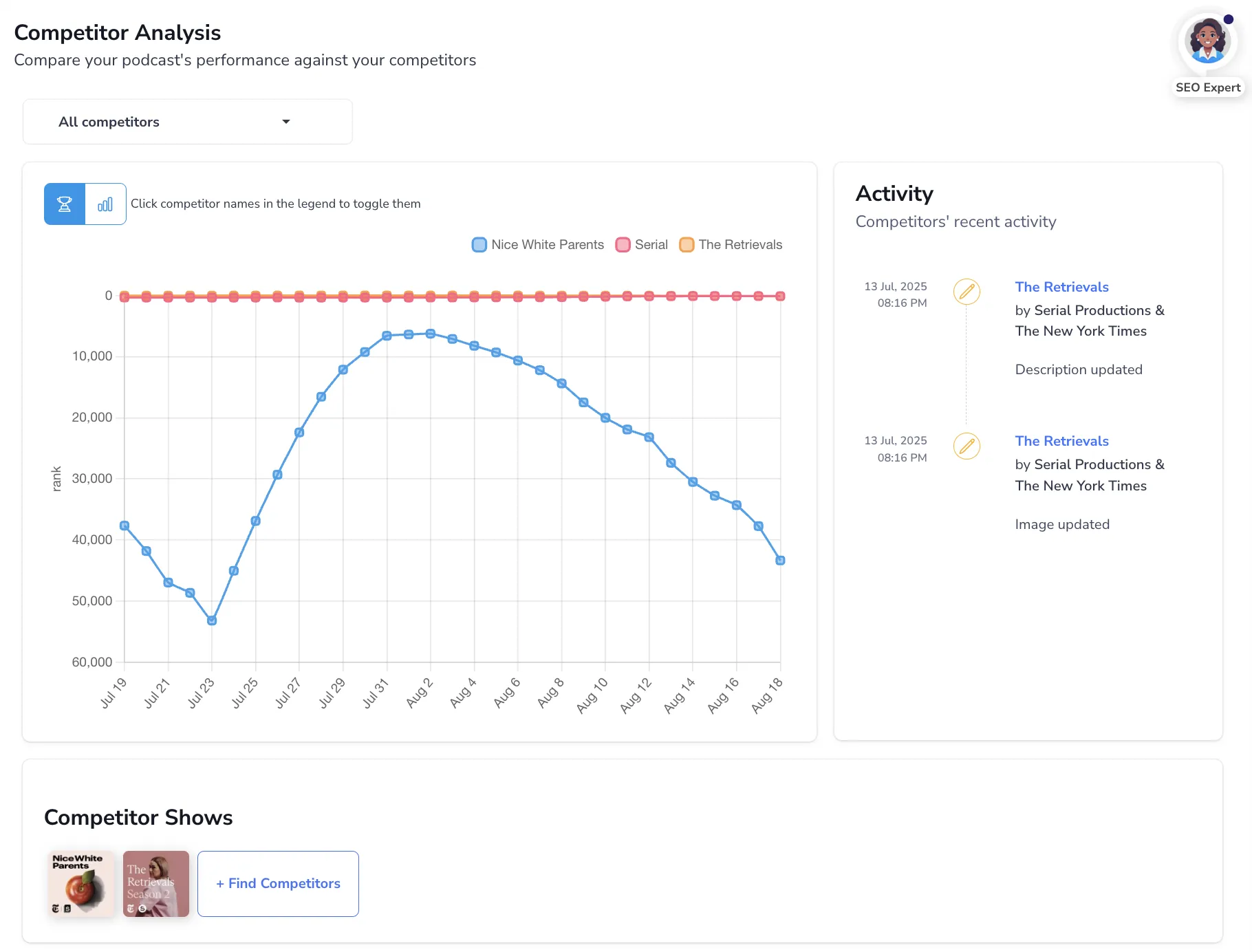
The Tabs You'll Work With
Competitive Analysis is organized into a few tabs. What you see depends on whether you're looking at your whole competitive set or focused on one competitor:
- Overview: Always available. Shows the big picture across everyone you track, and — when you've selected a competitor — a head-to-head "You vs. Them" comparison.
- Visibility Rank: Available when you're viewing all competitors. Ranks your tracked set by visibility so you can see exactly where you stand.
- Keywords: Replaces Visibility Rank once you select a specific competitor, giving you a per-platform keyword comparison against that show.
- Activity: Always available. A timeline of competitor episode releases and metadata updates from the last 30 days.
Adding and Managing Competitors
Click Add competitor to search for a show by name, by its Apple Podcasts or Spotify link, or by its RSS feed. Shows that are only listed in a non-US Apple Podcasts storefront can be added too — paste their Apple Podcasts link or ID. You can also track shows straight from Competitor Finder or Related Podcasts.
How many competitors you can track depends on your plan: Free tracks up to 2, Podcaster up to 4, Producer up to 25, and Agency and Enterprise are effectively unlimited. To make room for a new competitor, use Remove competitor on its row in the Overview table.
Two Ways to Analyze Your Competition
Competitive Landscape Overview
Get the big picture of how you're performing against all your tracked competitors at once:
- Competitor Comparison Table: Your own rank is pinned at the top, followed by each tracked competitor with their platforms, Visibility rank, 7-day trend (how many positions their global rank moved in the last 7 days — up means they climbed), and Episodes (30d), the number of episodes they released in the last 30 days. Click any competitor to open the head-to-head view.
- Competitive Positioning: On the Visibility Rank tab, see where you rank compared to all your tracked competitors over the past 30 days. Switch between Absolute (everyone's actual global visibility rank) and Relative (your position within your competitive set — 1st, 2nd, 3rd, and so on). Click names in the legend to show or hide individual competitors.
- Performance Trends: Spot whether you're gaining ground or falling behind in your competitive set
- Market Context: Understand your position within your immediate competitive landscape
- Strategic Opportunities: Identify competitors you can realistically overtake with focused effort
Head-to-Head Deep Dive
Select one competitor to open a focused "You vs. Them" comparison and get detailed strategic intelligence:
- Score Comparison: The Overview tab breaks down the three factors that drive your rank — Search score, Editorial score, and Chart score — and shows exactly how you and the competitor compare on each, including the difference in your favor (or theirs)
- Side-by-Side Drill-Downs: Below the score breakdown, compare your keyword ranks with theirs, then your platform features, web mentions, and chart appearances against the competitor's — so you can see exactly where a gap in the score comes from
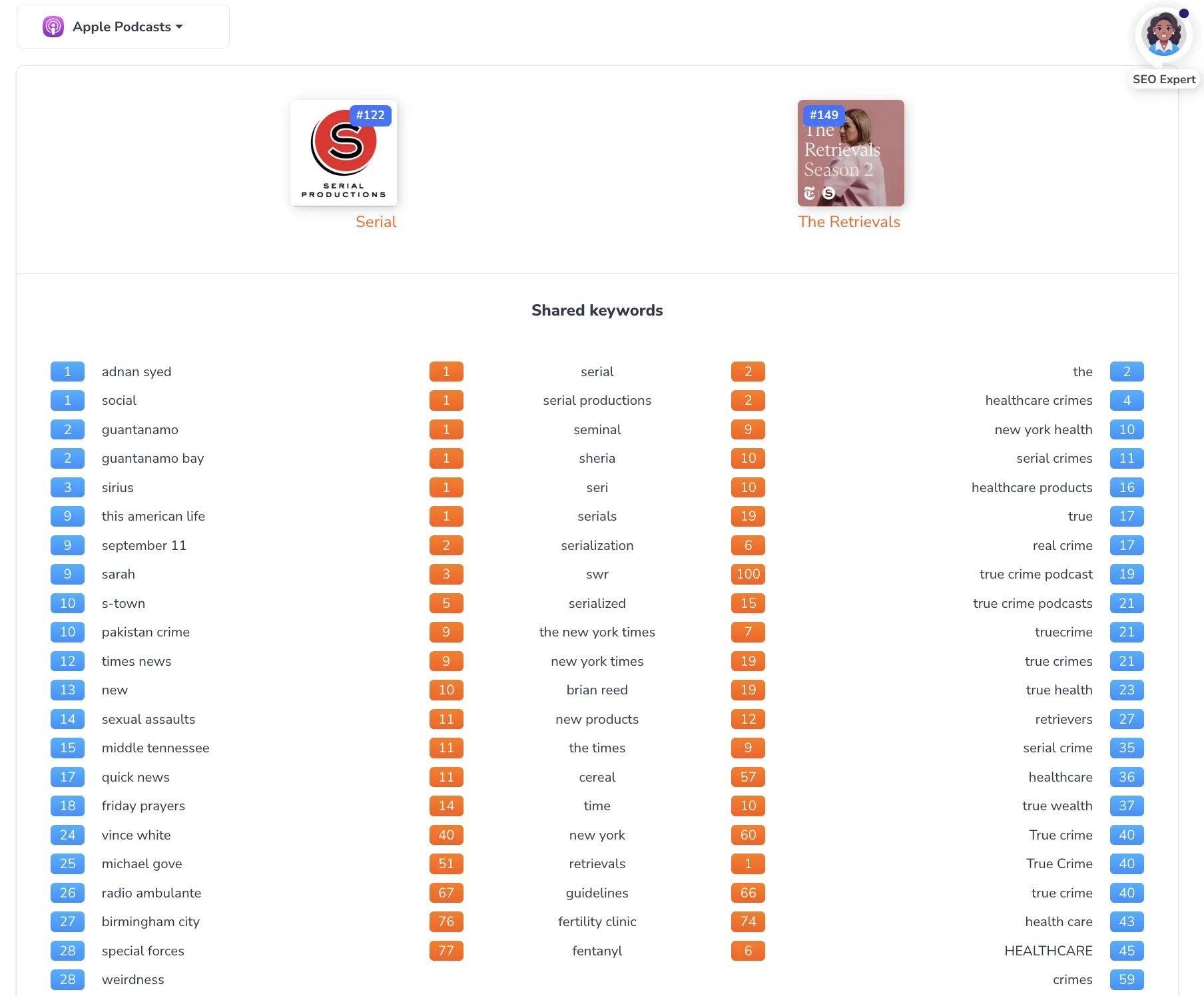
- Keyword Strategy Comparison: On the Keywords tab, discover which keywords you share, which ones they're winning that you're missing, and where you have unique advantages — switch the platform to compare across Apple Podcasts, Spotify, Amazon Music, and YouTube Music
- Content Activity Patterns: Track when they release episodes and update their podcast information
- Strategic Learning: Understand what's working for successful competitors in your space
Understanding Your Competitive Position
Two Ways to Measure Success
Competitive Analysis shows your performance in two valuable ways:
- Your Actual Performance: Track your real ranking improvements over time to see if your optimization efforts are working
- Your Competitive Position: See whether you're ranked 1st, 2nd, 3rd, etc. among your competitive set, regardless of absolute numbers
Spotting Trends and Opportunities
The visual charts make it easy to identify what's happening in your competitive landscape:
- Performance Momentum: Quickly see if you're gaining ground or losing position relative to competitors
- Opportunity Windows: Identify when competitors have weak periods that create opportunities for your content
- Strategic Timing: Understand the best times to launch new content or optimization campaigns
The Systematic Approach to Competitive SEO Analysis
Step 1: Identify Your SEO Competitors
Not all competitors are created equal for SEO purposes. Focus on podcasts that:
- Share Your Target Audience: Shows your ideal listener might choose instead of yours
- Compete for Similar Keywords: Podcasts appearing for search terms you want to rank for
- Demonstrate SEO Success: Shows consistently ranking in top positions for relevant searches
Tip: Look for keyword themes that appear across multiple successful shows in your niche. Track your most relevant competitors (Free tracks 2 and Podcaster 4), and use Competitor Finder and All Charts to study more shows in your space beyond the ones you track.
Step 2: Extract Their Keyword Intelligence
Analyze your competitors' metadata systematically:
- Podcast Titles: What keywords do they prioritize in their main title?
- Descriptions: Which terms appear repeatedly in their podcast descriptions?
- Episode Patterns: What keyword themes do they use consistently across episodes?
- Performance Correlation: Which of their keywords are driving the best rankings?
Reading the Keywords Tab
When you select a competitor, the Keywords tab shows a table of keywords for the platform you choose, with these columns:
- You and Them: Your rank and the competitor's rank for the keyword (a dash means no ranking)
- Gap: How many positions separate you
- Opportunity: How valuable the keyword is to go after
- Strategy: A badge that suggests what to do —
- Target: A high-opportunity keyword where the competitor ranks well
- Defend: You're ahead, but the competitor is close
- Your win: You rank and the competitor doesn't
- Monitor: Worth watching for changes
Click + Add on any row to add that keyword to your Keyword Strategy; keywords you already track are marked Tracked. On the Free plan you can see the first 3 keywords in full — the rest show their ranks with the keyword hidden until you upgrade.
Step 3: Turn Intelligence Into Strategic Action
This competitive keyword analysis reveals immediate opportunities:
High-Impact Keyword Gaps Identify keywords where successful competitors consistently rank well, but you're not competing at all. These represent your biggest opportunity for quick SEO wins.
Content Strategy Insights
- Topics Successful Competitors Cover: Areas where they're capturing search traffic you could compete for
- Keyword Integration Patterns: How they naturally incorporate target keywords into titles and descriptions
- Content Themes That Work: Proven topics and angles that drive consistent search visibility
Strategic Positioning
- Competitive Advantages: Keywords where you're already outperforming competitors - double down on these
- Winnable Battles: Keywords where competitors have weak positions you can realistically overtake
- Long-term Opportunities: High-value keywords where building authority over time could yield significant results
Learning From Competitor Activity
Understanding What Drives Success
Track exactly what successful competitors are doing and when:
- Content Strategy: See their episode release patterns and frequency
- Optimization Efforts: Notice when they update titles, descriptions, or other podcast information
- Performance Correlation: Understand which activities seem to drive their ranking improvements
- Strategic Timing: Learn optimal timing for content releases and optimization efforts
Strategic Applications
Use competitor activity intelligence to:
- Optimize Your Content Calendar: Avoid oversaturated release days or fill gaps when competitors are quiet
- Learn From Success: Identify optimization strategies that consistently work for successful competitors
- Stay Proactive: Spot trends in your competitive landscape before they become widespread
- Time Your Moves: Plan your own optimization campaigns when they'll have maximum impact
Activity Tab: Track Competitor Movements Over Time
The Activity tab within Competitive Analysis provides a timeline view of competitor actions — episode releases, metadata updates, and optimization efforts — helping you understand patterns and time your own moves.
What Activity Shows You
- Episode Release Patterns — See exactly when your competitors release new episodes. Avoid crowded release days or capitalize on gaps in competitor activity.
- Metadata Optimization Activity — Track when competitors update their podcast titles, descriptions, or categories. This reveals optimization campaigns and positioning shifts.
- Strategic Intelligence — Identify success patterns, spot market trends, and understand when your category is most active.
Reading the Activity Timeline
The Activity timeline is a vertical list of events from the last 30 days, newest first. Each entry shows the date and time, the competitor's name and author, and what happened — a new episode or a change to their podcast information. When you've selected a single competitor, the list shows only their activity. Click a competitor's name to open the head-to-head view. If nothing happened in the last 30 days, you'll see a "No recent activity" message.
Acting on Competitor Intelligence
- Content Timing — Schedule your episodes when you can maximize impact
- Optimization Opportunities — When competitors are updating metadata, consider whether similar updates could benefit your podcast
- Release Schedule Strategy — Compare your publishing consistency to successful competitors
Making the Most of Competitive Intelligence
Strategic Applications for Growth
Use competitive analysis to drive real improvements in your podcast's performance:
- Content Strategy: Identify content gaps where successful competitors aren't performing well, creating opportunities for your expertise
- Keyword Strategy: Discover proven keywords that competitors are using successfully, then optimize your own content around these terms
- Timing Strategy: Understand optimal timing for content releases and optimization efforts based on competitive patterns
- Differentiation Strategy: Find ways to stand out by offering value that competitors are missing
Setting and Achieving Competitive Goals
Competitive analysis helps you set realistic, achievable goals:
- Benchmark Performance: Understand what "good" performance looks like in your competitive landscape
- Progressive Targets: Set goals to outperform specific competitors rather than aiming for unrealistic jumps
- Market Context: Define success based on your competitive position and market opportunity
- Strategic Milestones: Track improvement relative to competitive performance over time
Best Practices for Competitive Success
Building Your Strategic Competitive Intelligence System
Quality Over Quantity: Focus on tracking competitors who truly compete for your target audience rather than trying to monitor everyone. Your goal is deep insights from relevant competitors, not surface-level data from everyone in your category.
Mix Performance Levels for Maximum Learning:
- Aspirational Competitors: Top-performing podcasts that represent your growth goals
- Peer Competitors: Shows at similar levels you can realistically overtake with focused effort
- Emerging Competitors: Newer shows that might be using innovative SEO strategies
Content Relevance Over Popularity: Prioritize competitors with similar content themes and target audiences over those that are only loosely related. A smaller, highly relevant competitor's keyword strategy may be more valuable than a massive show in an adjacent space.
Regular Strategic Reviews:
- Monthly: Quick competitive positioning checks and new keyword opportunities
- Quarterly: Complete reassessment of your competitor list as your podcast grows and your competitive landscape evolves
- After Major Changes: Review competitive landscape whenever you pivot content strategy or target new keyword themes
Developing Your Analysis Routine
- Weekly Check-ins: Spend 10-15 minutes weekly reviewing competitive trends and recent activity
- Monthly Deep Dives: Conduct comprehensive competitive analysis monthly to inform your strategic planning
- Event-Based Analysis: Pay special attention to competitor performance around major content releases or industry events
- Seasonal Planning: Use quarterly competitive landscape reviews to adjust your long-term strategy
Turning Analysis Into Action
The key to successful competitive analysis is moving from observation to strategic action:
- Keyword Strategy Updates: Use competitive keyword insights to refine your keyword targeting and content optimization
- Content Calendar Optimization: Plan your content releases and optimization campaigns based on competitive activity patterns
- Strategic Positioning: Adjust your podcast's positioning based on gaps and opportunities in the competitive landscape
- Performance Benchmarking: Set realistic goals and measure progress against competitive benchmarks
Integration with Your Growth Strategy
Connected Intelligence
Competitive Analysis works most effectively when integrated with your other optimization efforts:
- Keyword Strategy: Use competitive insights to inform which keywords to target and prioritize
- Planner: Add competitive context to your optimization — the AI Producer uses competitor data to identify content gaps
- Strategic Planning: Build competitive intelligence into your overall podcast growth strategy
Long-term Competitive Advantage
The podcasts that grow most successfully use competitive analysis not just to copy what others are doing, but to identify opportunities others are missing. Regular competitive intelligence helps you stay ahead of trends, spot market gaps, and position your podcast for sustainable growth in an increasingly competitive landscape.
Getting Started: Begin with the multi-competitor overview to understand where you stand in your competitive landscape, then dive into head-to-head analysis with your most relevant competitors to identify specific opportunities for growth and differentiation.