
Visibility Progress
See how your podcast's visibility changes over time, inspect its contributing factors, and review actions and observed signals from the same period.
To access: Measure → Timeline in the sidebar. The page is titled Visibility Progress.
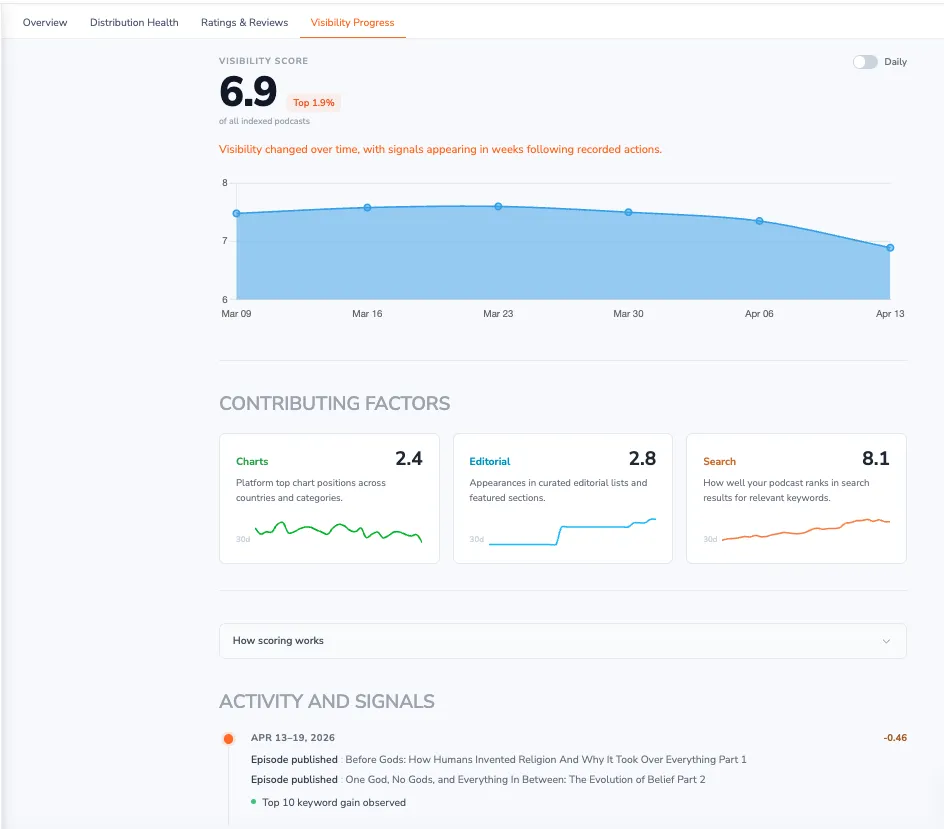
Read your Visibility Score
The headline Visibility Score summarizes your show's measured discovery opportunities on a 0–10 scale. A Top X% badge shows your relative placement when a rank is available; otherwise you see Rank pending. A short summary can highlight notable movement during the period.
The chart opens in Weekly view, which averages the daily scores within each week. Switch to Daily for individual readings. A quieter weekly line does not mean the daily changes disappeared; the two views summarize the same history differently.
Inspect the contributing factors
Each card shows a component's latest available value and a sparkline. Click the card to inspect the underlying results.
| Card | What contributes | Where it opens |
|---|---|---|
| Charts | Platform chart positions across countries and categories; higher positions contribute more | My Charts |
| Editorial | Recent platform-curated features and qualifying web placements; placement position, publication strength, and age matter | My Placements |
| Search | Observed show-level keyword positions across the four listening platforms, weighted by the chart visibility of shows ranking for those terms | Search Appearances |
Read each component against its own history. The cards have different display scales. Their numbers are neither percentages of the total nor values you can add together to calculate the headline score. A smaller number on one card does not by itself identify your biggest opportunity.
Understand the scoring explanation
The How scoring works section introduces Charts, Editorial, and Search. They contribute with different weights, and the overall score also reflects the show's recorded activity and Apple listing status. Improvements do not translate into equal increments on the displayed scale.
The section distinguishes Apple listing status, Recorded activity, and Global rank. Show optimization and episode alignment scores are separate from the Visibility Score, and a regular schedule does not earn a separate consistency bonus. Recent activity and listing status can affect the calculation; a metadata edit matters to visibility when the observed discovery results change.
Your global rank uses an average of recent scores over roughly the past week. The page's latest daily score, weekly chart averages, and rank can therefore move differently. See Visibility Score Explained for the full explanation.
Review Activity and Signals
The timeline groups the past thirty days into weeks and shows the score movement alongside two types of entries:
- Actions: recorded events such as published episodes and metadata changes.
- Signals: observed changes such as chart improvements, editorial placements, and keyword movement.
Weeks without recorded entries are marked clearly. Use the timeline to choose what to investigate. An action and a score change appearing in the same week do not establish that the action caused the change, and a quiet week can still have score movement.
Decide what to do next
If a component changes, open its detailed page before choosing a response:
- Charts: check which chart, country, or position changed.
- Editorial: review platform features and web placements, including their age.
- Search: inspect the relevant keyword positions, then use Tracker for the terms you want to follow.
Record live metadata edits and compare results over time. Check listening separately in Analytics: visibility measures discovery opportunities, rather than downloads or audience growth. A rising component confirms a change in the measured results; it does not prove which effort produced it.
Availability
Visibility Progress is available on paid plans. Free users see a locked preview with sample data and an Unlock Visibility Progress prompt. On a paid plan, your own score, contributing factors, and timeline appear as data becomes available.
For a practical routine connecting strategy, metadata, and results, follow the PodSEO workflow.