
The Complete Guide to Podcast SEO: Making Your Show Discoverable in 2027
Picture this: you've just released your latest podcast episode—the one you poured your heart into, complete with compelling interviews and golden insights. But here's the kicker: if people can't find it, even the most brilliant content falls into the digital void. That's where podcast SEO becomes your secret weapon.

A practical first step
Start with a question your next episode answers. For a balcony-gardening show, “how to grow tomatoes in pots” might become “Growing Tomatoes in Pots: A Beginner’s Balcony Guide.” Check that the episode delivers on the title. Before editing it in your host, note the current search position for that phrase, platform and country; compare the same details later. You do not need a large catalogue or a perfect strategy to begin.
Search position describes where a result appeared, not how many people listened. Review plays or downloads separately, using the reports available to you.
What Makes Podcast SEO Different (And Why It Matters)
Podcast-app search and web search are different surfaces. Your episode page can appear in a web search, while your show and episodes can appear in an app's own results. Measure each surface separately.
Think of it like this: when someone searches for "productivity tips" on Google, they might find your blog post. But when they search for the same term on Apple Podcasts or Spotify, each service uses its own signals. Titles, descriptions and transcripts can have different roles depending on the platform; no complete shared ranking formula is public.
Start with the listener you want to reach and the terms that describe your actual content. There is no need to estimate the total podcast market to choose a useful first keyword.
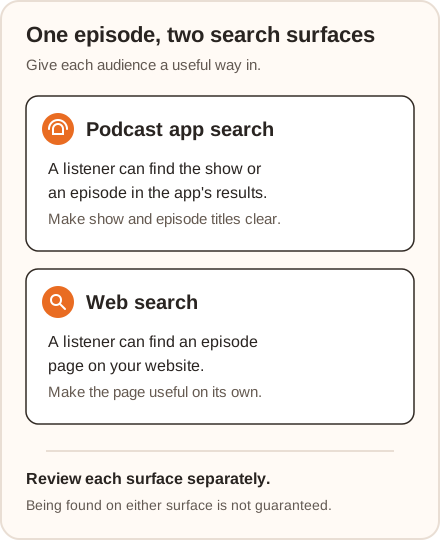
One episode, two search surfaces
Give each audience a useful way in.
- Podcast app searchA listener can find the show or an episode in the app’s results. Make show and episode titles clear.
- Web searchA listener can find an episode page on your website. Make the page useful on its own.
Review each surface separately. Being found on either surface is not guaranteed.
The Technical Foundation: Platform-Specific Optimization
Search, charts, editorial features and personalized recommendations are separate systems. Neither Apple nor Spotify publishes a complete ranking formula. Use the platform guide for documented guidance and clearly labelled observations.
Your host publishes titles, descriptions, artwork and audio links through your RSS feed. A valid feed supports distribution; it does not earn a documented search-ranking bonus simply for being technically clean.
PodSEO's Distribution → Check feed health provides a comprehensive analysis of your RSS feed, identifying technical issues and optimization opportunities to ensure your podcast meets platform standards.
Review your feed after a host migration or a metadata change. Choose categories that accurately describe the show and check where listeners browse. Do not assume a feed update frequency or an obsolete keywords tag improves search position.
To strategically approach keyword selection, PodSEO's Keyword Strategy feature helps you identify and organize the most impactful search terms for your podcast's growth.
Show Notes: Your SEO Powerhouse
Show notes represent your biggest untapped SEO opportunity. They give readers a text summary, links and reference points alongside the audio. But here's the thing—most creators treat them as an afterthought, missing a massive opportunity for organic discovery.
Effective show notes go beyond simple episode summaries. They should include timestamped topics, key quotes, mentioned resources, and guest information. This creates multiple entry points for search engines and provides value to listeners who might be scanning for specific information.
There is no universal ideal word count. Lead with the specific topic and listener benefit, then add timestamps and resources where useful. Keep an app description concise; a separate website article can provide more detail.
Consider this strategy: create show notes that could stand alone as valuable content. If someone stumbled upon your show notes without listening to the episode, would they still find value? This approach not only improves SEO but also demonstrates the quality and depth of your content to potential new listeners.
The Planner can help you optimize your episode descriptions and show notes to maximize their search potential and listener appeal.
Episode Titles: The Make-or-Break Moment
Your episode title should name the topic and a useful angle. Preview it in the apps your audience uses; titles may be shortened on small screens, so place the clearest information early. There is no universal 60-character SEO rule.
For practical patterns to try when writing episode titles, see our detailed guide: Episode Title Formulas That Actually Work.
One useful title pattern is: they lead with the primary keyword or topic, include a compelling angle or benefit, and create just enough curiosity to encourage clicks. For example, “Email Marketing: Welcome Emails for a New Store” names the topic more clearly than “Marketing Tips Episode 47.” Use a numerical result only when the episode supports it.
Here's an insider tip: analyze your download analytics to identify which title formats perform best with your audience. You might discover that question-based titles ("What's Really Driving the Creator Economy?") outperform declarative ones ("The State of the Creator Economy"), or vice versa. Treat the comparison as a clue: guest, topic, promotion and episode age may explain the difference.
PodSEO's Keyword Tracker can help you monitor how different title formats and keyword approaches impact your podcast's search rankings over time.
Transcription: The SEO Game-Changer
Transcriptions transform your audio content into searchable text, dramatically expanding your SEO footprint. But beyond the obvious search benefits, transcriptions improve accessibility, enable content repurposing, and provide material for social media snippets.
Check automatic transcripts for guest names, specialist terms and links before publishing or reusing them. Transcripts support accessibility and repurposing; whether they are indexed depends on the platform. See the platform guide rather than assuming every app searches all spoken content.
Consider this workflow: use your transcription as the foundation for multiple content pieces. A single episode transcript can become a blog post, multiple social media posts, email newsletter content, and even visual quote cards. This multiplies your SEO impact while maximizing your content creation efficiency.
The Long Game: Building Authority and Consistency
Plan metadata reviews as part of your publishing routine. A sustainable schedule helps listeners know when to return; it is not a documented universal ranking bonus. This means your SEO strategy should align with your content calendar and long-term goals.
Building topical authority requires patience and strategic focus. Rather than covering random topics, successful podcasters identify their niche and consistently deliver value within that space. This focus helps a prospective listener understand what to expect.
PodSEO's Planner can help you evaluate how well your current content aligns with your target keywords and identify opportunities to strengthen your topical authority.
You can treat each episode as part of a connected collection. They reference previous episodes, build on established themes, and create content series that keep listeners engaged across multiple episodes. This gives interested listeners a route to related episodes; measure whether they use it where your reports permit.
Measuring Success: Beyond Download Numbers
Keep download trends, episode engagement, follower growth and review feedback separate. They answer different questions; a review count is not a completion metric and a ranking is not an acquired listener.
Use only the discovery information the source reports. Apple does not expose a search-versus-browse breakdown. Spotify reports impressions by Home, Library and Search, with charts and editorial included in Search; those impressions are not keyword-attributed listeners. See the analytics guide.
PodSEO's Search Appearances shows observed search positions across listening platforms. Analytics adds listening and viewing reports from connected sources; keep those measurements separate when assessing changes.
The key is developing a measurement framework that aligns with your goals. If your podcast serves as a lead generation tool for your business, track how many listeners convert to email subscribers or customers. If you're building a media brand, focus on growth metrics and engagement rates.
The Future of Podcast Discoverability
As the podcast landscape continues evolving, staying ahead of SEO trends becomes increasingly important. Voice search optimization, AI-powered content recommendations, and cross-platform integration are reshaping how listeners discover new shows.
The creators who thrive will be those who understand that podcast SEO isn't just about gaming algorithms—it's about creating genuinely valuable content that serves listeners' needs while being technically optimized for discovery. This balance between human value and technical optimization will define successful podcasting in the years ahead.
Remember, the best SEO strategy is creating consistently excellent content that people actually want to find. When you nail that foundation, the technical optimization becomes the accelerant that amplifies your natural growth.
For practical implementation of these concepts, check out our 30-Day Podcast SEO Challenge for a step-by-step action plan to improve your podcast's discoverability.
Put this into practice
Choose a focused starting point: the keyword strategy blueprint for search terms, RSS feed optimization for distribution, or episode titles for your next release. First Steps walks through adding your show to PodSEO.
Explore PodSEO Search Visibility to see how it supports this work. You can sign up from the product page; check current plans for feature availability.